Statistics of Couples Who Find Each Other Again
The last few months of 2017 treated us to a whirlwind of news coverage on sexual harassment and corruption, with powerful men from Hollywood to Washington, D.C. falling because of sexual misconduct. It continues into the new year, with Missouri Governor Eric Greitens the latest to fall. And most of these men are married.
When Time mag picked the silence breakers as the 2017 "person of the year," few people paid attention to the other group of women negatively impacted by the fallout—the spouses of the men who engaged in inappropriate or fifty-fifty criminal (in some cases) sexual behavior. To these women, sexual harassment/corruption also means infidelity.
In general, men are more likely than women to cheat: 20% of men and 13% of women reported that they've had sexual practice with someone other than their spouse while married, according to information from the contempo General Social Survey(GSS).
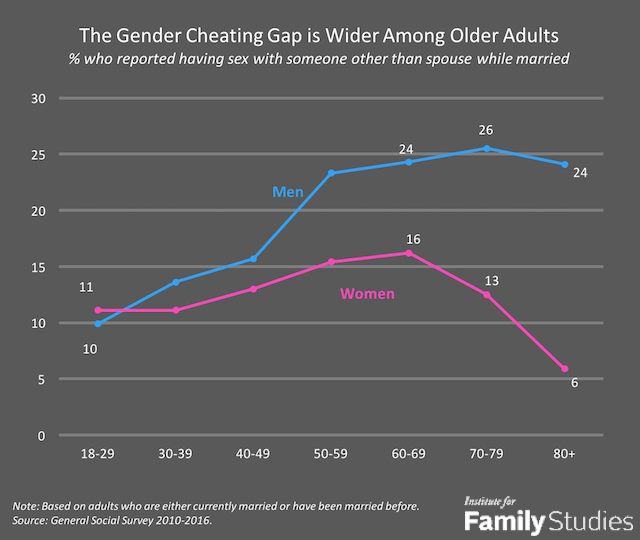
Yet, as the effigy above indicates, this gender gap varies by age. Amidst always-married adults ages eighteen to 29, women are slightly more likely than men to exist guilty of adultery (11% vs. x%). Just this gap apace reverses among those ages 30 to 34 and grows wider in older historic period groups. Infidelity for both men and women increases during the middle ages. Women in their 60s report the highest charge per unit of infidelity (16%), but the share goes downwardly sharply amongst women in their 70s and 80s. By comparison, the infidelity charge per unit amongst men in their 70s is the highest (26%), and it remains high amid men ages 80 and older (24%). Thus, the gender gap in cheating peaks among the oldest age group (ages fourscore+): a divergence of 18 percentage points betwixt men and women.
Trend data going back to the 1990s suggests that men accept always been more likely than women to cheat. Even so, older men were no more likely to cheat than their younger peers in the past. In the 1990s, the infidelity charge per unit peaked among men ages 50 to 59 (31%) and women ages 40 to 49 (xviii%). Information technology was lower for both men and women at the older end of the age spectrum. Between 2000 and 2009, the highest rate of adultery shifted to men ages 60 to 69 (29%) and women ages 50 to 59 (17%). Meanwhile, the gender gap at ages 80+ increased from 5% to 12% in 2 decades.
A generation or cohort issue is likely to contribute to this shifting gender gap in adultery. As Nicholas Wolfinger noted in an earlier postal service, Americans built-in in the 1940s and 1950s reported the highest rates of extramarital sexual activity, perhaps because they were the first generations to come of age during the sexual revolution. My analysis by gender suggests that men and women follow a slightly different age pattern when it comes to extramarital sex. Women born in the 1940s and 1950s are more likely than other women to be unfaithful to their spouse, and men built-in in the 1930s and 1940s have a higher rate than other age groups of men. The college infidelity rates among these two cohorts contribute to the changing design in the gender gap equally they grow older over fourth dimension.
In addition to gender and age, the adultery rate as well differs by a number of other demographic and social factors. For example, cheating is somewhat more common amid blackness adults. Some 22% of ever-married blacks said that they cheated on their spouse, compared with 16% of whites and 13% of Hispanics. And amongst blackness men, the rate is highest: 28% reported that they had sex with someone other than their spouse, compared with 20% of white men and 16% of Hispanic men.
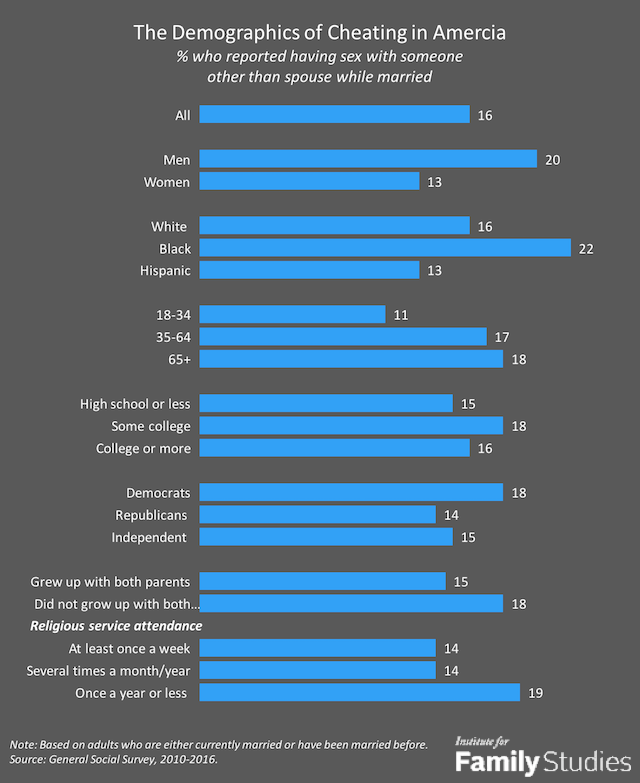
A person's political identity, family background, and religious activity are also related to whether or not they cheat. Overall, Democrats, adults who didn't abound up in intact families, and those who rarely or never attend religious services are more probable than others to have cheated on their spouse. For example, xv% of adults who grew upwards with both biological parents have cheated on their spouse before, compared with xviii% of those who didn't abound upward in intact families.
On the other paw, having a college degree is not linked to a higher take chances of cheating. Virtually equal shares of college-educated adults and those with high school or less education have been unfaithful to their spouse (16% vs. fifteen%), and the share among adults with some college didactics is slightly higher (eighteen%).
Given that many of these factors could be interrelated, I ran a regression model to examination the independent effect of each gene. Basically, holding all other factors equal, volition each factor yet exist related to the odds of adulterous? Information technology turned out that most of these differences (such as age, race, party identity, religious service attendance, family background) are significant, fifty-fifty afterward controlling for other factors. And a person'due south education level is not significantly associated with cheating.
However, when information technology comes to who is more likely to cheat, men and women share very few traits. Split up regression models by gender suggest that for men, beingness Republican and growing up in an intact family are non linked to a lower chance of adulterous, after controlling for other factors. But race, age, and religious service attendance are nonetheless pregnant factors. Likewise, men'south education level is also positively linked to their odds of adulterous. By comparison, party ID, family unit groundwork, and religious service omnipresence are still meaning factors for adulterous among women, while race, age, and educational attainment are not relevant factors. In fact, religious service attendance is the only cistron that shows consequent significance in predicting both men and women'due south odds of infidelity.
Infidelity is painful to the person who is being cheated on and can exist detrimental to the relationship. Although statistics on the link between infidelity and divorce are hard to notice, my analysis based on GSS information suggests that adults who cheated are much more than likely than those who didn't to be divorced or separated.
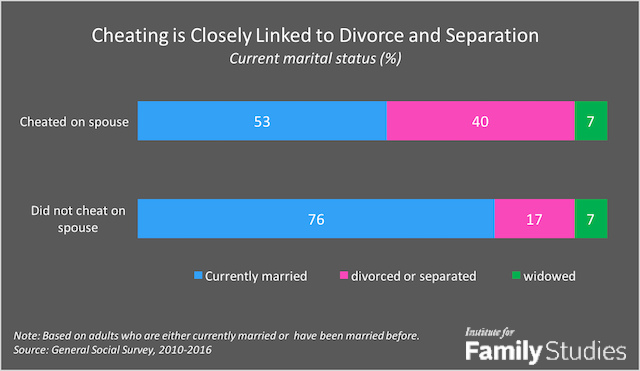
Among ever-married adults who have cheated on their spouses before, forty% are currently divorced or separated. By comparison, only 17% of adults who were true-blue to their spouse are no longer married. On the flip side, only most half of "cheaters" are currently married, compared with 76% of those who did not crook.
Men who cheated are more likely than their female peers to be married. Among men who have cheated on their spouse before, 61% are currently married, while 34% are divorced or separated. However, only 44% of women who accept cheated before are currently married, while 47% are divorced or separated.
This gender deviation could reflect the fact that men are more likely to be remarried than women after a divorce. A portion of currently married "cheaters" may be remarried, since we tin't tell from the data whether or non the person who cheated is still married to the spouse he or she cheated on.
Wendy Wang is manager of enquiry at the Found for Family unit Studies and a erstwhile senior researcher at Pew Research Center, where she conducted research on marriage, gender, work, and family life in the Us.
Statistics of Couples Who Find Each Other Again
Source: https://ifstudies.org/blog/who-cheats-more-the-demographics-of-cheating-in-america
0 Response to "Statistics of Couples Who Find Each Other Again"
Post a Comment